The Productive Commute: Why Elite Executives Are Rethinking Who Holds the Wheel
Let us be direct about something that the business world rarely states plainly: driving yourself to a meeting is, for most senior executives, a poor use of your most finite resource.
This is not a statement about status. It is a statement about mathematics. If your time is valued at several hundred dollars per hour—and for many C-suite leaders, that figure is conservative—then the forty-five minutes spent navigating traffic to an airport or a client dinner represents a meaningful economic cost. More importantly, it represents an opportunity cost: time that could have been spent preparing, thinking, recovering, or simply arriving in a mental state that serves you and the people you are about to meet.
Professional chauffeur services have long been associated with luxury and prestige. That association is accurate, but it is incomplete. Increasingly, the executives and entrepreneurs who rely on services like Ace Plus Luxury Car Service do so not primarily for the leather seats or the chilled water—though these are welcome—but for the measurable, demonstrable competitive advantage that comes from reclaiming time behind the wheel.
The Hidden Cost of Driving Yourself
Most professionals do not think of driving as work. They think of it as a neutral activity—something that happens between the things that matter. This framing, while understandable, is worth examining carefully.
Driving requires cognitive load. It demands sustained attention, rapid decision-making, and a degree of vigilance that, even for experienced drivers, consumes mental bandwidth. After a long drive in urban traffic, the brain does not arrive fresh. It arrives depleted—subtly, perhaps, but meaningfully.
Neuroscience research consistently demonstrates that cognitive fatigue impairs decision-making quality, emotional regulation, and the kind of nuanced interpersonal attunement that high-stakes business interactions require. The executive who drives herself through an hour of Los Angeles freeway traffic before a board presentation is not, despite her best efforts, operating at full capacity when she walks into that room.
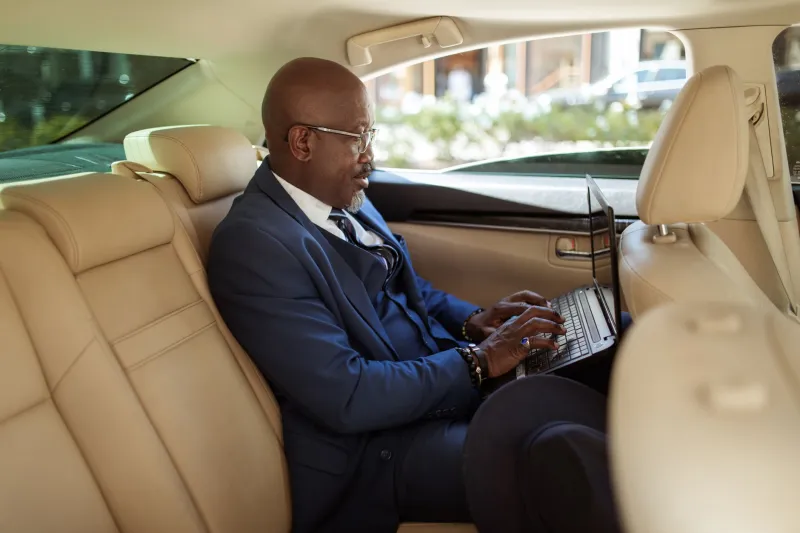
The executive who spent that same hour in the back of a chauffeured vehicle—reviewing her notes, taking a call, or simply sitting in deliberate silence—is.
What Executives Actually Do in the Back Seat
Speaking with senior professionals who regularly utilize luxury car services reveals a surprisingly varied picture of how that reclaimed time is used—and how intentionally it is managed.
A managing director at a private equity firm described his morning routine this way: "I use the drive to the airport almost exclusively for the one call I've been putting off. There are no interruptions, no colleagues walking by. It's actually the most productive thirty minutes of my day."
A chief marketing officer based in Chicago takes a different approach. "I don't work in the car. I use it to transition. I listen to something that has nothing to do with work—a history podcast, music. By the time I arrive at a client meeting, I'm genuinely present rather than still mentally in the last meeting."
A founder and CEO who travels between New York and Washington, D.C. frequently noted the wellness dimension: "I've started treating the car as a mobile recovery space. I do breathing exercises, sometimes a short meditation. I arrive at meetings in a state that I genuinely couldn't access if I'd been driving."
These are not isolated anecdotes. They reflect a broader shift in how high-performing professionals think about the interstitial moments of their workday—and the growing recognition that those moments, properly managed, compound into a significant competitive advantage.
The Wellness Argument That Business Leaders Are Finally Hearing
Corporate wellness has evolved considerably in recent years. Where once it was confined to gym memberships and annual health screenings, it now encompasses sleep optimization, stress management, cognitive performance, and the systemic design of work environments that support sustained high performance.
In this context, the professional chauffeur service fits naturally into the toolkit of the performance-conscious executive. It is, at its core, a stress-reduction mechanism with productivity benefits.
The elimination of parking anxiety alone—a genuinely underrated stressor for urban professionals—has measurable effects on cortisol levels and pre-meeting composure. Add to this the removal of navigation decisions, traffic frustration, and the physical tension of urban driving, and the cumulative relief is substantial.
Several executive coaches and performance consultants have begun explicitly recommending luxury car services to high-achieving clients who report feeling perpetually rushed and cognitively overextended. "Arriving somewhere is a skill," one New York-based executive coach observed. "Most people arrive frazzled and spend the first ten minutes of a meeting recovering. That's not a great strategy."
Reframing the Investment
The conversation around luxury car services in a business context often stalls at the question of cost. This is understandable. Professional chauffeur services represent a premium over rideshare platforms and personal vehicle use, and in an environment of budget scrutiny, that premium requires justification.
The reframe that changes this conversation is straightforward: stop categorizing luxury car service as a travel expense and start categorizing it as a productivity investment.
If a senior executive's time is worth $500 per hour, and a chauffeured journey reclaims two hours of productive time per week that would otherwise be lost to driving, the weekly value generated is $1,000. Over a year, that figure approaches $50,000—a return that dwarfs the cost of the service itself by a considerable margin.
This arithmetic does not account for the subtler benefits: the quality of decisions made when arriving refreshed rather than depleted, the impressions formed by clients who observe the professionalism with which your team operates, and the reduction in executive burnout that comes from systematically removing unnecessary friction from the workday.
The Professional Standard That Speaks Before You Do
There is one final dimension of the professional chauffeur service that deserves acknowledgment, and it is perhaps the most difficult to quantify.
How you arrive communicates something about who you are and how you operate. This is not vanity—it is professional signaling, and it functions whether or not you intend it to.
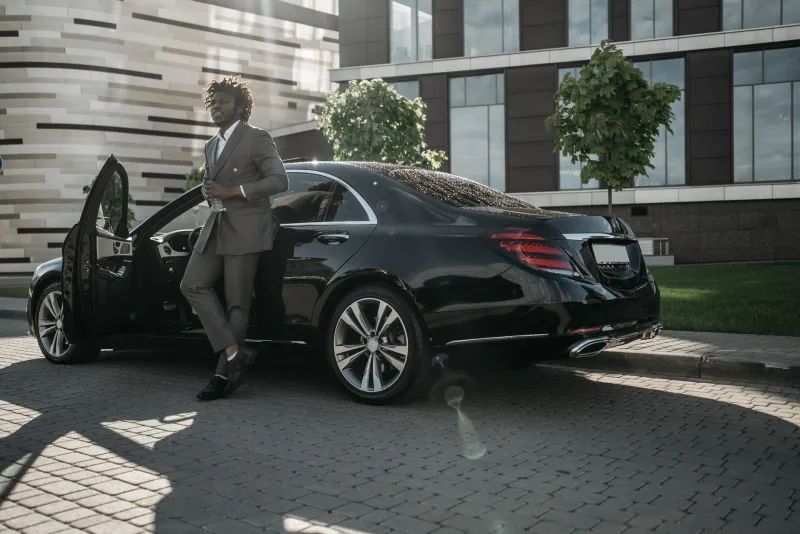
An executive who steps out of a well-maintained, chauffeured vehicle projects command, organization, and an understanding of the value of time. These are not trivial impressions in a business culture where credibility is established rapidly and often on incomplete information.
At Ace Plus Luxury Car Service, we work with executives who understand that every element of their professional presentation matters—including, and sometimes especially, how they travel. Our chauffeurs are trained to operate with discretion, professionalism, and a genuine commitment to the client's comfort and schedule.
Because the most successful professionals know that winning often begins before the meeting starts—and that how you arrive is the opening move.