First Class Is Not the Finish Line: How Ground Transportation Completes the Elite Travel Formula
The flatbed seat. The pre-departure champagne. The noise-canceling headphones and the curated meal service at thirty-five thousand feet. For decades, first-class air travel has been synonymous with elite business mobility, and for good reason—it offers genuine comfort, privacy, and the ability to rest or work during a cross-country or transatlantic flight.
But here is the question that rarely appears on a corporate travel policy: what happens at either end of that flight?
For many executives, the answer is a frustrating sequence of events that quietly dismantles everything the premium cabin was designed to protect. A rushed rideshare pickup. A crowded terminal departure. An unfamiliar driver circling the wrong terminal. By the time the boardroom comes into view, the composure cultivated at altitude has already been compromised—on the ground.
The most effective executive travelers have recognized something the aviation industry would rather you not consider: the flight itself is often the easiest part of the journey.
Where Business Travel Actually Breaks Down
Consider the anatomy of a typical same-day business trip from, say, Chicago to New York. The flight is roughly two and a half hours. But the total travel experience—door to destination—is something else entirely.
The executive leaves home, navigates to O'Hare or Midway, manages check-in, clears security, waits at the gate, boards, flies, deplanes, retrieves baggage if checked, and then navigates ground transportation on the other end. The premium cabin accounts for perhaps thirty percent of the total elapsed time. The remaining seventy percent unfolds largely in environments the traveler cannot control—and that airlines cannot improve.
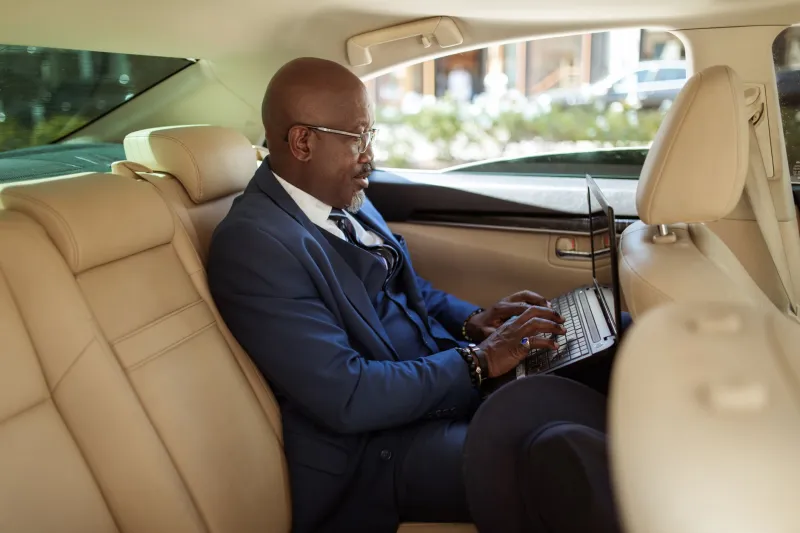
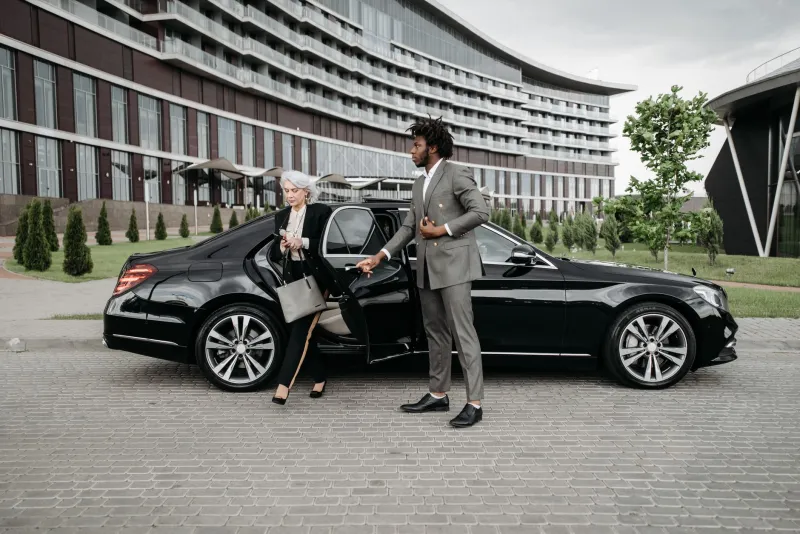
This is precisely where luxury ground transportation earns its place at the strategy table. When a professional chauffeur handles both departures and arrivals, the traveler's total experience shifts dramatically. Curbside pickup is precise and punctual. The vehicle is a mobile workspace, not a waiting room. Arrival at the destination is composed, not harried. The executive steps out of the car ready to lead a meeting—not recover from a journey.
The Time-Value Equation No One Is Running
Executives routinely calculate the value of upgrading a seat. They rarely calculate the cost of an unproductive transfer.
A forty-five-minute rideshare delay, a ten-minute search for a driver, or a stressful highway sprint to make a connection—these are not minor inconveniences. For a senior professional whose billable hour or deal-making capacity is measured in the thousands of dollars, lost time in transit carries real financial weight.
Professional chauffeur service reframes that math entirely. When ground transit time becomes productive time—calls completed, documents reviewed, presentations rehearsed—the cost of the service is not an expense. It is a recovery of value that would otherwise be surrendered to logistical friction.
The executive who lands at JFK or LAX and steps directly into a reserved, waiting vehicle retains momentum that no amount of premium cabin comfort can manufacture after the fact.
The Psychological Dimension of Seamless Arrival
There is a dimension to elite travel that balance sheets do not easily capture: psychological readiness.
High-stakes business demands cognitive clarity, emotional steadiness, and the kind of confident presence that communicates authority before a word is spoken. These qualities are not impervious to the cumulative stress of disorganized travel. A delayed pickup, a driver who requires directions, a vehicle that does not meet expectations—each of these micro-stressors extracts something from the executive's mental reserve.
Luxury ground transportation, managed by a service with the professional standards of Ace Plus Luxury Car Service, eliminates that extraction. The vehicle is confirmed. The route is planned. The driver is briefed. The traveler's only obligation is to think, prepare, or simply decompress. That preserved mental capital is often what separates a compelling presentation from a merely adequate one.
Rethinking the Upgrade Calculus
The conventional wisdom in corporate travel is to allocate premium spend toward the flight itself—and to treat ground transportation as a commodity to be managed at minimum cost. This logic is understandable but increasingly difficult to defend.
Consider that a first-class domestic upgrade may cost several hundred to several thousand dollars, depending on the route and carrier. That investment delivers a superior in-flight experience, which is genuinely valuable. But it does nothing to address the forty-five minutes before departure or the hour after landing—time that, without intentional planning, is frequently the least productive and most stressful portion of the entire journey.
A more sophisticated approach redistributes attention—and budget—across the full travel arc. Reliable, premium ground transportation at both ends of the flight does not compete with first-class air travel. It completes it. The two work in combination to produce a travel experience that is coherent from origin to destination, rather than excellent in one dimension and chaotic in others.
Logistics as Leadership
There is a less obvious argument for luxury ground transportation that speaks directly to the executive mindset: control.
Leadership is, in part, the discipline of reducing variables. The executive who arrives at a high-stakes negotiation having managed every element of their transit—who was not at the mercy of surge pricing, app failures, or an unfamiliar driver—has already demonstrated, at least to themselves, a capacity for ordered execution. That quiet confidence is not theatrical. It is the byproduct of a travel strategy that was designed rather than improvised.
At Ace Plus Luxury Car Service, the philosophy is straightforward: every mile of the journey deserves the same standard of excellence you bring to the work itself. The fleet, the drivers, the coordination—these are not amenities. They are infrastructure.
The Complete Travel Strategy
For executives who invest seriously in their professional effectiveness, the question is no longer whether to fly premium. It is whether the premium experience extends to the full journey.
The answer, increasingly, is yes—and the mechanism is professional luxury ground transportation. Not as an indulgence, but as a deliberate component of a travel strategy designed to protect time, preserve composure, and deliver the traveler to the moment that matters most in the best possible condition.
First class gets you there. Ground transportation strategy gets you there ready.
That distinction, measured across a year of business travel, is not trivial. It is the difference between a travel budget and a competitive advantage.