What Your Commute Is Actually Costing You: A Hard Look at Time, Money, and the Executive Equation

There is a quiet assumption embedded in the daily routines of many high-achieving professionals: that driving oneself is the practical, financially responsible choice. It feels self-sufficient. It feels in control. And for the vast majority of Americans, it is simply what one does.
But for executives, entrepreneurs, and senior decision-makers whose time carries genuine monetary weight, that assumption deserves rigorous scrutiny. Because when the full arithmetic is applied — when hourly value, cognitive load, and opportunity cost are factored into the equation — the calculus shifts in a direction that many find genuinely surprising.
Professional luxury car service, when measured against what it actually replaces, frequently costs less than the alternative.
The First Number You Need to Know: Your Real Hourly Rate
The exercise begins with an honest calculation. According to data from the Bureau of Labor Statistics and compensation platforms such as Levels.fyi and Payscale, a C-suite executive at a mid-size American company earns, on average, between $250,000 and $600,000 annually in total compensation. A successful entrepreneur or founder in a growth-stage business may operate at a comparable or higher effective rate once equity and revenue generation are considered.
Divide a $350,000 annual compensation package by 2,080 working hours, and the result is approximately $168 per hour. For those earning $500,000, that figure climbs to roughly $240 per hour. Senior partners at law firms or consulting practices frequently exceed $400 per billable hour.
Now consider the American average commute. The U.S. Census Bureau places it at approximately 27 minutes each way — but for professionals in major metropolitan areas such as New York, Los Angeles, Chicago, or Atlanta, that figure often doubles or triples. A 45-minute commute each direction translates to 90 minutes of daily driving. At $168 per hour, that is $252 in time value lost every single working day. Over a 250-day work year, the total reaches $63,000.
For the $240-per-hour executive, that same commute represents $90,000 annually — simply evaporating behind the wheel.
The Hidden Costs That Don't Appear on the Invoice
The hourly rate calculation, while illuminating, is only the beginning. There are compounding costs that rarely appear in any personal budget review but are no less real for their invisibility.
Cognitive depletion is perhaps the most underappreciated of these. Research published in the Journal of Occupational and Environmental Medicine has consistently linked long commutes to elevated stress hormones, reduced decision-making capacity, and diminished creativity. For professionals whose value lies precisely in strategic thinking and sharp judgment, arriving at the office — or a board meeting, or a client presentation — already mentally taxed is not a trivial matter. It is a performance liability.
Vehicle ownership overhead adds another layer. The American Automobile Association estimates that the average annual cost of owning and operating a mid-range vehicle in the United States exceeds $10,000 when insurance, depreciation, fuel, maintenance, and financing costs are aggregated. For professionals driving premium vehicles, that figure climbs considerably higher — often to $18,000 or more per year.
Parking in urban centers compounds the expense further. Monthly parking in downtown Manhattan averages over $500. In Chicago's Loop or downtown San Francisco, rates range from $300 to $450 monthly. These are recurring costs that accumulate with little fanfare.
What Professional Chauffeur Service Actually Provides in Exchange
This is where the comparison becomes particularly instructive. A professional luxury car service does not merely transport a person from one location to another. It converts transit time — previously lost — into productive, recoverable time.
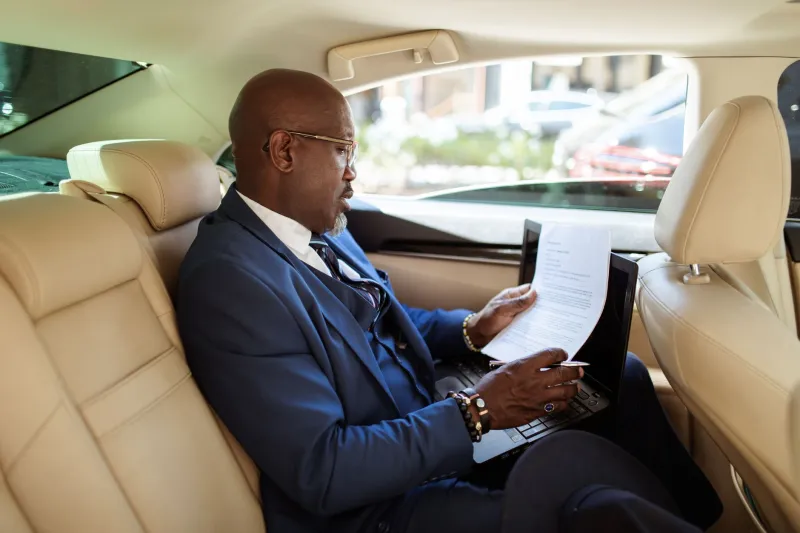
Within a properly appointed luxury vehicle, an executive can conduct calls, review briefing documents, compose correspondence, prepare for negotiations, or simply decompress in genuine privacy. The vehicle becomes, in effect, a mobile office or a mobile sanctuary, depending on what the moment requires.
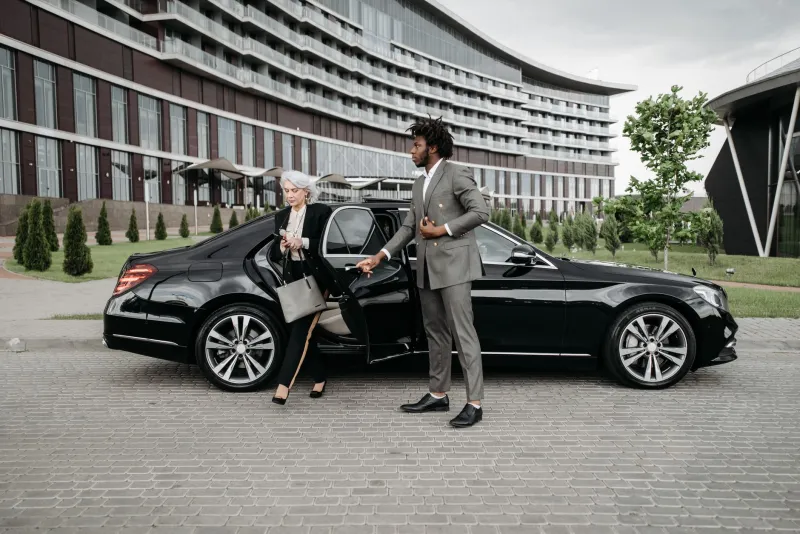
Ace Plus Luxury Car Service equips its fleet with this professional reality in mind. Quiet, climate-controlled cabins, discreet and trained chauffeurs, and the kind of punctual reliability that removes scheduling anxiety from the equation entirely — these are not amenities in the decorative sense. They are functional tools for professionals who cannot afford to waste the hours between engagements.
If a 90-minute daily commute is converted from dead time into productive time, the value recovered at $168 per hour is $252 per day — the same figure that was previously being lost. The service does not merely reduce cost; it creates a net recovery.
Running the Numbers Side by Side
Consider a practical comparison for an executive earning $350,000 annually, commuting 90 minutes per day in a luxury vehicle they own:
- Annual vehicle ownership cost: $18,000
- Annual parking (urban): $5,400
- Annual time cost at $168/hour (90 min/day × 250 days): $63,000
- Cognitive performance degradation: Difficult to quantify, but meaningful
- Total effective annual cost: approximately $86,400
Now consider a professional luxury car service used for the same commuting pattern. Depending on market and usage frequency, executive car service in major U.S. cities typically ranges from $75 to $150 per hour. At $120 per hour for 90 minutes daily over 250 working days, the annual service cost approximates $45,000.
With vehicle ownership and parking costs eliminated, and with 90 daily minutes converted from unproductive to productive time, the net position improves dramatically — and that is before accounting for the reduction in stress, the elimination of weather and traffic anxiety, and the professional impression made upon arrival.
The Perception Dimension
There is a dimension to this conversation that transcends personal productivity, though it is no less relevant to the business case. How a senior professional arrives at a meeting, a negotiation, or a client event communicates something before a single word is spoken. The composed, unhurried individual who steps from a well-appointed vehicle carries a different energy than the one who has spent 45 minutes in stop-and-go traffic, circled a parking garage, and walked three blocks in inclement weather.
For those whose professional reputation is itself a revenue-generating asset — the consultant, the investor, the senior partner, the founder — that first impression is not a soft consideration. It is part of the value proposition.
Rethinking What "Expensive" Actually Means
The instinct to classify luxury car service as a premium expense is understandable. The line item is visible; the costs it displaces are not. But rigorous analysis consistently reveals that for professionals operating at senior levels of compensation, the decision to drive oneself is frequently the more expensive choice — measured in time, in energy, in vehicle overhead, and in the compounding cost of arriving less than fully prepared.
At Ace Plus Luxury Car Service, the proposition is straightforward: your time has a precise value, and protecting it is not an indulgence. It is sound financial reasoning.
The question worth asking is not whether you can afford professional transportation. For many high-earning professionals, the more accurate question is whether you can afford to continue without it.