Rethinking the Cost of the Driver's Seat: A Financial Case for Professional Chauffeur Service
There is a particular kind of logic that tends to govern the thinking of high-achieving professionals: if something can be done personally, doing it personally is the more responsible choice. Driving oneself to a morning board meeting, an airport terminal, or a client dinner feels efficient on the surface. It feels controlled. But surface-level reasoning rarely survives contact with rigorous analysis — and when it comes to the true cost of self-driving, the numbers are far more revealing than most executives expect.
At Ace Plus Luxury Car Service, we work with a clientele that values precision in every domain of their professional lives. Yet even among the most analytically minded clients, the assumption persists that a personal vehicle represents savings over a chauffeured alternative. This article is a direct challenge to that assumption.
The Foundational Question: What Is Your Hour Actually Worth?
Before any meaningful cost comparison can be made, one figure must be established with clarity: the dollar value of a single hour of your productive time.
For a senior executive earning $400,000 annually, a straightforward calculation places the hourly value of working time at approximately $192 — and that figure does not account for the compounding value of high-leverage decisions, client relationships, or strategic thinking that characterizes executive work. For business owners, attorneys, surgeons, and financial professionals, the effective hourly rate frequently exceeds $300 to $500 or more.
Now consider a typical morning commute in a major metropolitan area — Chicago, Los Angeles, New York, Dallas. Door-to-door transit during peak hours commonly consumes 45 to 90 minutes. When that time is spent behind the wheel navigating traffic, that duration is, by definition, unproductive. It cannot be recovered. Replicated across 220 working days per year, a 60-minute daily commute at a $300 hourly rate represents over $66,000 in forfeited productive time annually.
That figure alone reframes the entire conversation.
The Parking Equation Nobody Adds Up
Parking in American urban centers is a cost that professionals tend to absorb without scrutiny because it arrives in small, forgettable increments. A $35 garage fee in Midtown Manhattan. A $28 valet charge at a downtown Chicago hotel. A $22 airport short-term parking receipt in Houston. These numbers feel minor in isolation.
They are not minor in aggregate.
A professional who drives to client meetings, airport departures, and business dinners four times per week in a major city can reasonably accumulate $400 to $600 in monthly parking expenditures — over $5,000 to $7,000 annually. Add traffic violation risk, the occasional tow, and the administrative friction of finding and managing parking logistics, and the figure climbs further still.
A professional chauffeur service eliminates this category of expense entirely. There is no parking fee when your vehicle returns to a staging area while you conduct your meeting. There is no circling the block, no time spent searching for a space, and no cognitive overhead devoted to logistics that should never have occupied executive mental bandwidth in the first place.
Depreciation, Maintenance, and the Vehicle You'd Rather Not Think About
The Internal Revenue Service places the standard mileage rate for business driving at 67 cents per mile for 2024 — a figure intended to approximate the true all-in cost of vehicle operation, including fuel, insurance, depreciation, and maintenance. For a professional driving 15,000 business miles annually, that translates to over $10,000 in vehicle-related costs, conservatively estimated.
Luxury vehicles depreciate with particular aggression in their early years. A flagship sedan that commands a $95,000 purchase price may shed $20,000 or more in value within the first 24 months of ownership. Every mile driven accelerates that depreciation curve. Every highway journey, every urban stop-and-go cycle, and every parking structure interaction represents a reduction in asset value that rarely appears in a professional's mental accounting.
When the vehicle in question is a personal symbol of status — as it often is for senior executives — the psychological reluctance to acknowledge its cost is even more pronounced. But the cost exists regardless of whether it is acknowledged.
Stress as a Quantifiable Liability
The physiological effects of commuting stress are well-documented in occupational health research. Driving in congested conditions elevates cortisol levels, increases blood pressure, and measurably degrades cognitive performance in the hours that follow. For professionals whose effectiveness depends on sharp thinking, composed demeanor, and the capacity to make high-stakes decisions, arriving at a destination in a state of elevated stress is not a minor inconvenience — it is a performance liability.
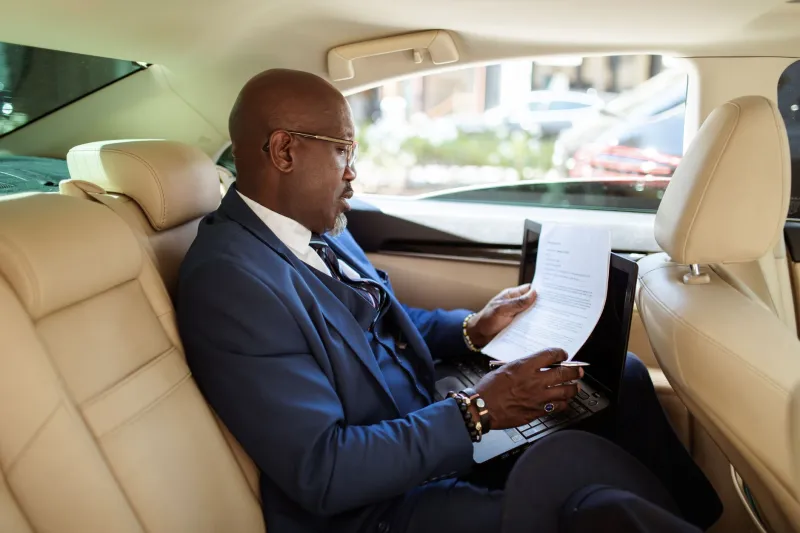
Consider what it means to step out of a chauffeured vehicle having spent the preceding 45 minutes reviewing briefing materials, preparing remarks, or conducting a focused phone call in a climate-controlled, acoustically refined environment. The contrast with a driver who has just navigated a congested interstate is not merely one of comfort — it is one of readiness.
Clients who rely on Ace Plus Luxury Car Service consistently report that the quality of their engagement in meetings, the clarity of their thinking, and their overall composure improve meaningfully when professional transportation replaces self-driving. These are not soft benefits. They translate directly into professional outcomes.
The Comparison Rendered Plainly
Let us construct a straightforward annual comparison for a senior professional in a major American city:
Self-Driving (Estimated Annual Costs)
- Forfeited productive time (60 min/day × 220 days × $300/hr): $66,000
- Parking and related fees: $6,000
- Vehicle depreciation, fuel, insurance, maintenance: $12,000
- Stress-related performance degradation (conservative estimate): Incalculable, but real
Total estimated annual cost of self-driving: $84,000+
Professional Chauffeur Service (Estimated Annual Investment)
- Premium chauffeur service, 220 business days, urban market: $30,000–$55,000
The arithmetic is not subtle. For a professional whose time carries genuine value, delegating transportation is not a luxury expenditure — it is a rational reallocation of resources.
A Different Kind of Investment Mindset
The executives and high-net-worth individuals who engage professional chauffeur services on a consistent basis rarely describe the decision in terms of convenience. They describe it in terms that are fundamentally financial: recaptured hours, eliminated friction, protected performance, and the compounding value of arriving at every engagement in optimal condition.
This is the philosophy that underpins the Ace Plus Luxury Car Service model. Every vehicle in our fleet, every rigorously vetted chauffeur, and every detail of the service experience is designed to function as an extension of a client's professional infrastructure — not as an indulgence, but as an instrument.
The hidden cost of driving yourself is not found in the fuel receipts or the parking tickets. It is found in the hours quietly surrendered, the focus gradually eroded, and the opportunities that arrive when you are not yet ready to meet them.
The question worth asking is not whether you can afford professional chauffeur service. It is whether, given the full accounting, you can afford not to consider it.