Reclaiming the Hours: How Professional Chauffeur Service Pays for Itself in Productivity
There is a peculiar financial blind spot shared by some of the most analytically rigorous professionals in America. These are individuals who scrutinize vendor contracts, optimize operational budgets, and obsess over return on investment — yet they routinely climb behind the wheel of their own vehicles and absorb, without calculation, the full cost of doing so. That cost is rarely measured in dollars alone. More often, it is measured in hours.
For high-earners, time is not merely money in a metaphorical sense. It is money in a deeply literal one. When a senior partner at a law firm, a C-suite executive, or a founder billing at several hundred dollars per hour spends ninety minutes navigating a congested interstate corridor, the financial consequence of that decision is both real and quantifiable. Professional chauffeur service, viewed through this lens, ceases to be an indulgence and becomes one of the most defensible line items in a high-performer's operational budget.
The Arithmetic of the Commute
Consider a straightforward scenario. A business attorney based in Chicago bills her time at $450 per hour. Her daily commute — door to office and back — consumes approximately two hours when accounting for driving, parking, and the mental transition time required before and after. That is $900 in potential billable time absorbed by logistics, five days a week, across a standard work year.
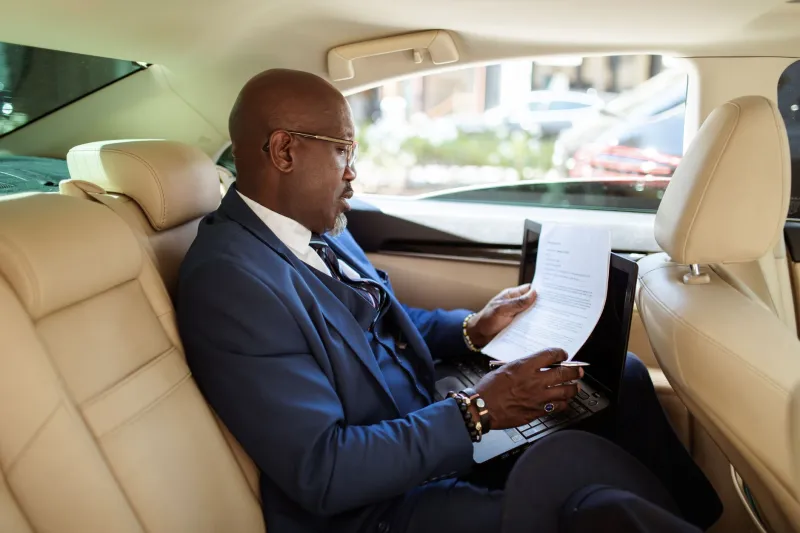
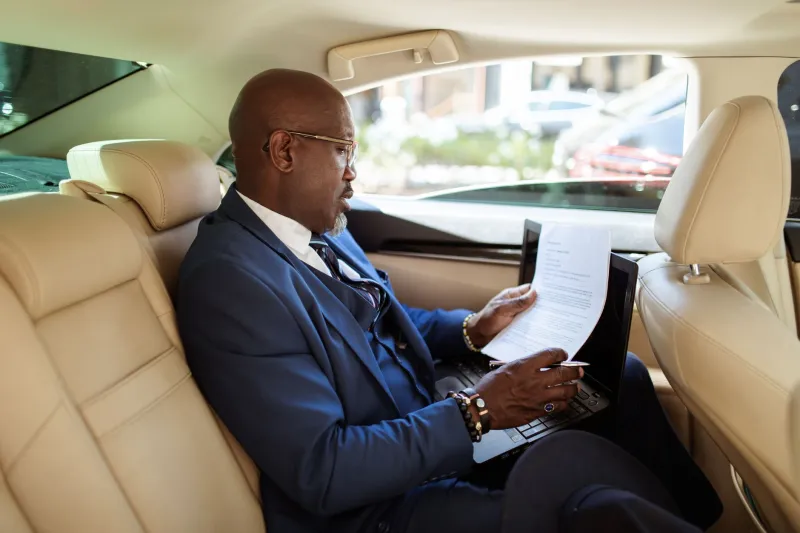
Now introduce a professional chauffeur. The cost of a premium round-trip service within the city runs, on average, a fraction of what that attorney stands to reclaim in productive transit time. During those same two hours, seated in the rear of a well-appointed vehicle, she can review briefs, respond to client correspondence, participate in conference calls, or simply arrive at her destination mentally composed rather than traffic-worn. The arithmetic is not complicated. The reclaimed value dwarfs the service fee.
This is not an isolated case. Entrepreneurs, investment professionals, senior consultants, and medical specialists across the country are arriving at the same conclusion through their own calculations. The moment professional transportation is treated as a productivity tool rather than a comfort upgrade, the financial conversation changes entirely.
The Invisible Cost of Driving Yourself
Self-driving carries costs that rarely appear on any balance sheet, yet they accumulate steadily. There is the cognitive load of navigation — particularly in unfamiliar cities or during peak-hour congestion — which consumes mental bandwidth that might otherwise be directed toward preparation or problem-solving. There is the physical fatigue of extended highway driving before a high-stakes meeting. There is the time lost to parking logistics: finding a structure, walking to a destination, and reversing the process under deadline pressure.
Perhaps most underappreciated is the cost of arrival quality. A professional who has just navigated forty-five minutes of stop-and-go traffic arrives differently than one who has spent that same interval reviewing notes in a climate-controlled cabin. The former is reactive and depleted; the latter is composed and prepared. In environments where first impressions carry consequence — a boardroom, a client dinner, a keynote address — that distinction has tangible value.
Transit as a Productive Environment
One of the most significant behavioral shifts reported by executives who transition to regular chauffeur service is the discovery that transit time becomes genuinely useful time. The rear cabin of a premium vehicle, properly appointed, functions as a mobile office. With reliable connectivity, quiet acoustics, and freedom from the demands of driving, professionals find themselves completing work they would otherwise push into evening hours.
A venture capital partner based in New York described his experience after switching to a dedicated car service for his weekly travel between Manhattan and meetings in the tri-state area: "I used to arrive at investor meetings having spent the drive mentally rehearsing talking points while also watching the GPS. Now I arrive having actually reviewed the deck, taken two calls, and answered my most urgent emails. The meetings go better. The relationships go better. It compounds."
This compounding effect — where reclaimed transit time produces downstream improvements in performance, relationship quality, and decision-making — is difficult to capture in a single ROI calculation. Yet it is consistently reported by professionals who have made the transition.
Stress as a Hidden Tax
Beyond the quantifiable hours, there is the matter of stress — a variable that economists rarely model but that high-performing professionals understand intuitively. Chronic commute-related stress has well-documented effects on cognitive performance, emotional regulation, and long-term health outcomes. For individuals operating at the highest levels of professional demand, arriving at engagements already depleted by transportation friction is a structural disadvantage.
Professional chauffeur service removes that friction entirely. The vehicle arrives. The professional boards. The journey unfolds without decision fatigue, without navigational anxiety, without the ambient stress of traffic unpredictability. What is delivered at the destination is not merely a body in a seat — it is a professional at full capacity.
The Business Case for Premium Mobility
For organizations considering professional transportation as a benefit or operational investment, the calculus extends beyond individual productivity. When senior leaders arrive punctually, prepared, and composed at client engagements, the quality of those interactions improves. Deals close more smoothly. Relationships deepen. The organization's brand is reinforced by the manner in which its people show up.
Many companies have begun treating executive transportation not as a perquisite but as a strategic resource — one that protects the productivity of their highest-leverage employees and signals to clients that precision and professionalism extend to every detail of the engagement.
Reframing the Investment
The question worth asking is not whether professional chauffeur service is expensive. The more useful question is: expensive relative to what? Relative to the value of the hours it returns, the mental clarity it preserves, and the professional quality it enables, the cost differential between self-driving and premium transportation services frequently resolves in favor of the latter.
At Ace Plus Luxury Car Service, we work with executives, entrepreneurs, and high-performing professionals across the country who have made precisely this calculation. The conclusion, arrived at independently and repeatedly, is consistent: when time is your most finite resource, the most strategic investment you can make is in protecting it.
The vehicle is waiting. The question is simply what you intend to do with the hours it returns to you.